Interdisciplinary. Application-oriented. Forward-thinking.
The Institute of Computer Engineering (ZITI) dedicates its research and teaching activities to the understanding and implementation of complex systems in information technology. One research aspect is to analyze how new results in mathematics and fundamental physics may lead to innovative and intelligent computer systems. Another research focus is the application of new technologies and methods in computer engineering to sensing and instrumentation in physics, astronomy, biology, medicine and other natural and life sciences.
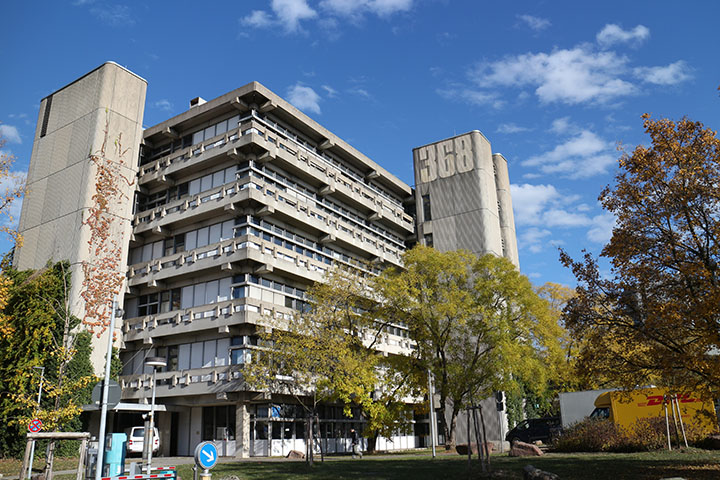
Three main features characterize the profile of computer engineering in Heidelberg: multidisciplinarity, application-orientation, and orientation towards the future. Due to their broad competences, our chairs are able to bring together their diverse knowledge and their different methodological approaches in order to jointly develop integrated hardware and software solutions. This synergistic combination distinguishes ZITI from classical departments of computer science at many other universities. Thus, research and teaching contents can be aligned constantly with current, as well as with future requirements. From the beginning, ZITI has always put an emphasis on market-oriented education for our graduate students, to enable them to meet their future responsibilities in industry and in research.
The result is an innovative orientation towards current and future developments, an internationally leading position in several research areas, lively spin-off activities and an academic education, tailored to meet market demands.
Next Colloquium Talk
Corey Lammie from IBM Research – Zurich presents recent advances in heterogeneous in-memory computing systems from a full-stack perspective.
Latest news
IEEE SOCC 2026 brings together researchers, industry professionals, and students from around the world to discuss the latest advances in System-on-Chip technologies.
Effective October 1, 2026, Dr. Yu will join ZITI of University Heidelberg as a Professor, where she will continue her research and teaching in integrated circuits, sensors and systems.
HeiChips 2026 brings together students, researchers, and industry to explore open-source chip design through lectures, hands-on workshops, and a week-long hackathon in Heidelberg.
Dr.-Ing. Enrica Tricomi has been awarded the 2026 Bertha Benz Prize by the Daimler and Benz Foundation for her dissertation.
International Symposium on Highly Efficient Accelerators and Reconfigurable Technologies (HEART)